 |
 |
|
|
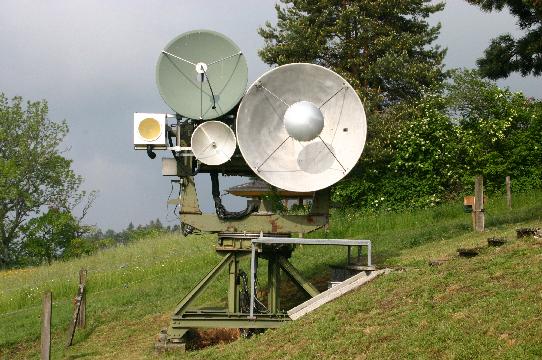
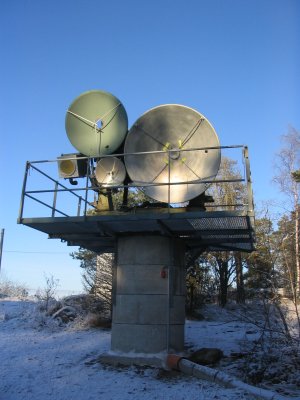
Tuorla solar instrumentsThe researchers in the Tuorla solar group have extensive experience in both observing the Sun and analysing solar radio data, as several people of our current staff were trained at the Metsähovi Radio Observatory as PhD students. Solar radio observations at millimetre wavelengths using the Metsähovi 14-m radio telescope were started over twenty years ago. As the Metsähovi antenna is not a solar-dedicated instrument and it provides solar data only on occasional campaigns, Tuorla has invested on new radio instrumentation at the Tuorla Observatory itself.Tuorla has acquired the multi-frequency solar radio polarimeter system, earlier operated by IAP at the University of Bern in Switzerland. The fully automatic antenna with it's five radiometers will be able to observe the Sun continuously in the microwave-millimeter wave regime (at 8, 12, 19, 35,and 50 GHz). As the optically thick emission turns into optically thin emission around 10 GHz for most solar flares, this gives ample opportunity to study electron energy distributions, magnetic field changes, and polarization signatures during solar eruptions. As this system provides no spatial information for the radio emission, the imaging capabilities of the larger Metsähovi antenna at high frequencies (22, 37 and 89 GHz) will be a valuable addition. Our future goal is to upgrade some of the mm-wave solar receivers, to get better sensitivity. The acquisition of a solar spectrometer operating in the decimetric-metric frequency range is also being planned. The upgraded and complemented system would provide us full spectral information on flares and eruptions from meter to millimeter waves, with additional spatial information. The Finnish summertime will also give us uninterrupted observing time for at least 16 hours/day. The Bern polarimeter data observed between 1990 and the present date will be implemented into the Tuorla-Bern solar polarimeter data archive (TUBE). At the moment, the TUBE archive contains selected solar bursts recorded in 2001-2004. Software for the full analysis of the data is being written and will be added to the worldwide free analysis solar software package SolarSoft, which is a set of integrated software libraries, data bases, and system utilities that provide a common programming and data analysis environment for Solar Physics. Similar software already exist for the Nobeyama Polarimeter data in Japan, and this data and software have been widely used by researchers and students at Tuorla. We have established a close collaboration with the Nobeyama Solar Radio Observatory over the years, and these two instruments complement each other by covering two different time zones for observations. |